
Live
Outcome: compare mutually exclusive projects using NPV, interpret IRR and payback, and detect nonconventional cash flows. Prerequisite: lesson 1.
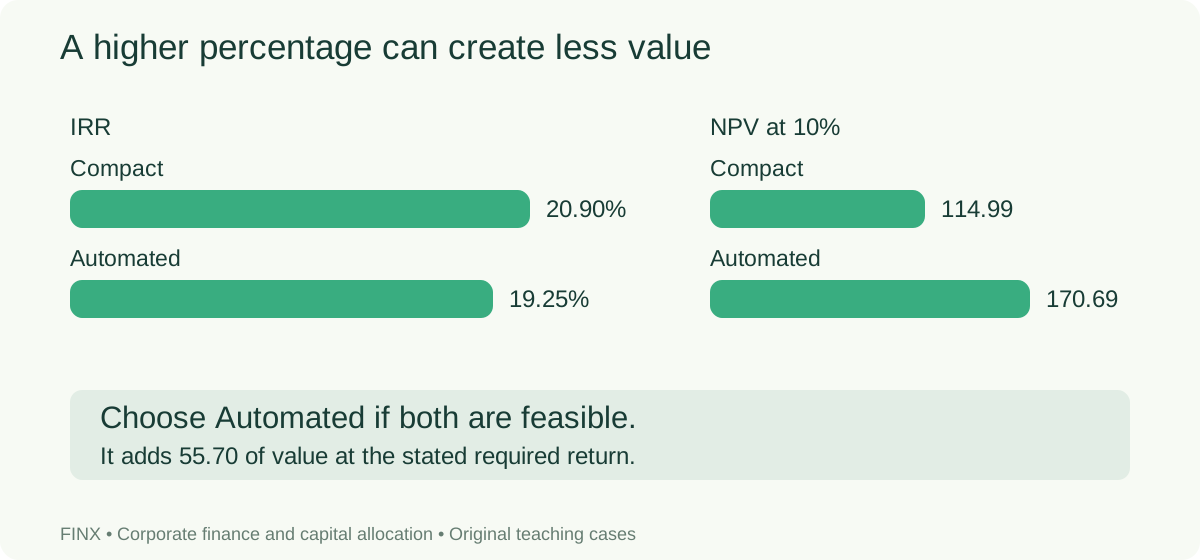
Compact earns a higher percentage return. Automated adds more value at the stated 10% required return. Before calculating, predict which line Larch should choose if both are affordable and their risk and life are comparable.
Discount each annual cash flow to time zero: PV = cash / (1 + rate)^year. Add the negative initial investment without discounting it. Excel's ordinary NPV starts discounting its first cash-flow argument one period from now. With time zero in C5 and years 1–4 in D5:G5, use =C5+NPV(rate,D5:G5). Passing C5:G5 into NPV discounts the initial outlay too.
| Four-year investment | Compact | Automated |
|---|---|---|
| Initial cash required | 440.00 | 770.00 |
| NPV at 10% | 114.99 | 170.69 |
| IRR | 20.90% | 19.25% |
| Simple payback, assuming even annual operating receipts | 2.75 years | 2.87 years |
IRR is the discount rate that sets the project's NPV to zero. Compact's higher IRR does not tell us how much total value it creates. Automated requires 330 more and adds 55.70 of present value. Under these assumptions and with capital available, choose Automated. If the extra capital is unavailable, that feasibility constraint changes the choice.
Payback answers a timing question about recovering the initial outlay. Simple payback ignores the time value of money and cash after the cutoff. Discounted payback corrects only the first weakness. Here the fractional-year figures assume receipts arrive evenly; the formal valuation assumes end-year flows. On a strict year-end basis, both recover their undiscounted outlays at year 3. Use the convention that fits the decision and label it.
An IRR acceptance rule works cleanly for an initial outflow followed by inflows when the required return is appropriate. It can mislead for scale differences, timing differences, financing-style cash flows and nonconventional sign changes. For −100, +230, −132, both 10% and 20% are IRRs. At 15%, NPV is about +0.19. A spreadsheet's single returned root is not a complete decision rule. Inspect the NPV profile and use the chosen required return.
Check: prove both roots by direct discounting. At 10%, −100 + 230/1.10 − 132/1.10^2 = 0; at 20% the same identity holds. Do not force an iterative IRR function to choose your preferred root.
Try it: At 10%, project A costs 100 and returns 130 in one year. B costs 500 and returns 620. Which has the higher IRR, and which creates more value if they are mutually exclusive and both feasible?
Reasoned solution: A has 30% IRR and 18.18 NPV; B has 24% IRR and 63.64 NPV. Choose B on NPV under the stated constraints. It creates 45.45 more value.
Transfer question: Would borrowing at 6% make 6% the correct project discount rate? No. Debt pricing measures one financing claim; required project returns must reflect the risk of the operating cash flows.
Optional reading: OpenStax on IRR.