
Live
Northstar Bottles reports revenue of 120 and cash of 35. Is the business large? Can it pay a bill of 20? You cannot tell yet. The numbers need labels. Revenue might be $120,000 for a month, while cash might be $35 million at a year-end. A correct calculation with mismatched labels still answers the wrong question.
By the end of this lesson: you can read a financial number as an amount with a unit, scale, time basis, sign and definition. You do not need a spreadsheet. A pencil and calculator are enough.
Use six questions before doing arithmetic: What does it measure? In what unit? At what scale? For which date or period? Under what sign convention? Is it an observed amount or an assumption?
| Item | Properly labeled value | What it means |
|---|---|---|
| Revenue | $120,000 for January | Sales recognized during a month |
| Cash | $35,000 at January 31 | Cash held at one moment |
| Bottles sold | 4,000 in January | A count during a period |
| Selling price | $30 per bottle | Dollars for each unit |
| Forecast sales | 4,400 bottles for February | An assumption about a future period |
Revenue is the amount earned from sales before subtracting expenses. An expense is a cost recognized in measuring profit. Profit is revenue minus the relevant expenses. Cash is money available; cash flow describes receipts and payments over a period. These are related concepts, but their timing can differ.
Northstar can deliver bottles worth $3,000 to a customer in January and receive payment in February. That sale can create January revenue without a January cash receipt. Conversely, collecting an old invoice creates cash without creating a new sale. Later accounting lessons explain recognition rules in more detail; here, the crucial habit is to avoid using “revenue,” “profit” and “cash” interchangeably.
Imagine a water tank. The water inside at noon is a snapshot. Water entering during the next hour is a flow. Opening water plus inflow minus outflow equals closing water. The analogy describes a reconciliation; money has additional accounting categories that water does not.
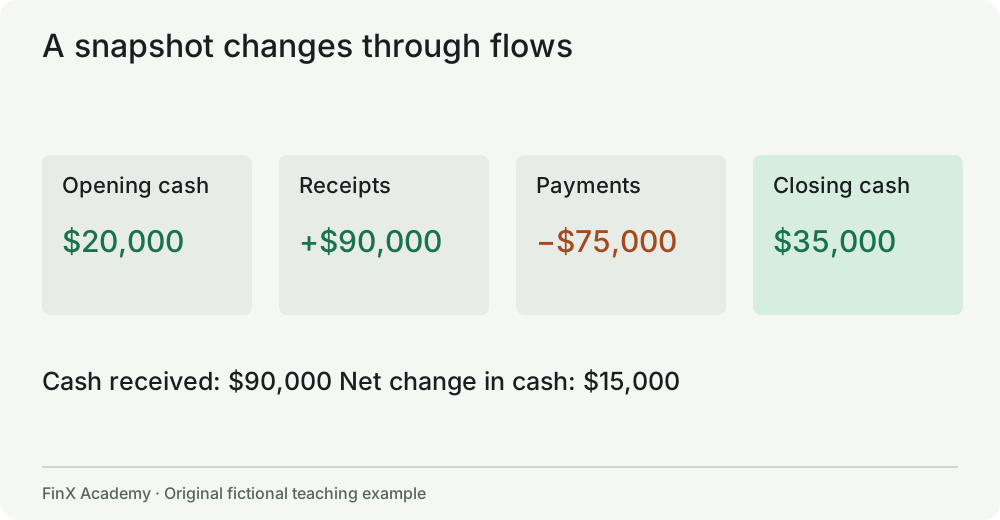
For cash, the same bridge is:
Closing cash = opening cash + cash received − cash paid.
If Northstar starts January with $20,000, receives $90,000 and pays $75,000, it ends with $35,000. Adding the opening and closing balances would not produce “cash generated.” It would add two snapshots. The change in cash is $15,000; receipts are $90,000. Both are useful, but they answer different questions.
Debt, inventory and receivables are also balances measured at dates. Revenue, expenses and cash flow normally cover periods. To compare a balance with a flow, explain the relationship. Inventory divided by annual cost of sales is a fraction of a year, not a profit margin. Multiplying that fraction by days per year converts it into an approximate number of days of inventory.
“$000” means thousands of dollars. A reported 120 in a $000 table means $120,000. To express it in $millions, divide 120 by 1,000: $0.12 million. Multiplying by 1,000 again would be a million-fold error relative to the correctly converted million-unit figure.
Check an equation through its units: 4,000 bottles × $30/bottle = $120,000. Bottles cancel. By contrast, multiplying a price by revenue creates dollars squared per bottle, which is not revenue. Unit checks often reveal a mistake before a detailed calculation does.
A currency is part of a unit. You cannot add dollars and euros without an exchange-rate convention. At an illustrative rate of $1.10 per euro, €10,000 equals $11,000: euros cancel when multiplied by dollars per euro. The inverse quotation is about €0.9091 per dollar. The two quotations describe the same conversion; multiplying by the wrong one reverses it. The rate here is a fictional teaching input, not a current exchange-rate quote.
Compare January with January, or a complete year with a complete year. A company's fiscal year need not end in December. Annualizing a quarter by multiplying by four is an assumption about the remaining quarters, not a fact. It can be misleading for a seasonal business.
State whether payments are positive amounts that you subtract or negative cash flows that you add. Both conventions work. Mixing them subtracts an outflow twice. Parentheses such as (75) often denote a negative amount, but read the table's convention. A dash can mean zero, unavailable or not applicable; a blank is not automatically zero.
Keep sufficient precision during calculations and round the final display. Reporting a forecast to the nearest cent does not make its assumptions accurate. A sensible answer combines reproducible arithmetic with an honest level of precision.
Transfer task: find a financial table and annotate one number with its unit, scale, date or period, definition and sign. If a label is missing, state the question you would ask instead of guessing.