
Live
Outcome: reconcile reported performance to a clearly defined analytical measure, accepting and rejecting adjustments with evidence. Normalization is an analyst judgement, not permission to label every inconvenient cost unusual.
Begin with reported earnings and log each candidate's amount, sign, period, source, recurrence, cash timing, tax treatment and decision. Apply the same policy to gains and losses and across years. Do not present adjusted results without the reported comparison. The SEC's non-GAAP interpretations explain why removing ordinary recurring operating costs or changing recognition principles can mislead. This course's analyst comparison is not a legal compliance opinion.
| 2025 candidate, USD millions | Signed effect | Decision |
|---|---|---|
| Completed factory closure | +12 | Accept provisionally under N3; show recurrence sensitivity |
| Asset-sale gain | −8 | Remove with disposal evidence N4 |
| Annual reorganization | +5 | Reject: similar costs recur |
| Stock compensation | +9 | Reject for earnings: recurring employee cost |
| Product-launch marketing | +7 | Reject: supports recurring product replacement |
| Future cost savings | +10 | Reject: not a historical expense |
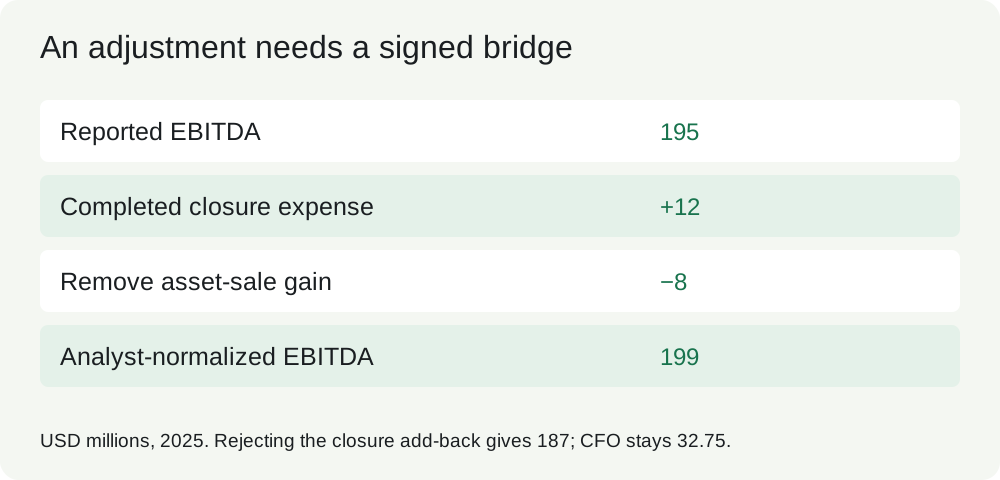
Reported EBITDA is 195. Accepting the closure and removing the gain gives 195 + 12 − 8 = 199. A management-style proposal adding all five positive candidates would show 238 and retain the gain. The 39 difference comprises rejected add-backs of 31 plus the omitted gain removal of 8. Reconcile this difference explicitly.
The closure choice is ambiguous. A completed site, invoices and a board-approved exit support treating that specific charge separately. The memo also mentions another review without a quantified program. A defensible conservative answer rejects the closure add-back until recurrence is resolved, producing 195 − 8 = 187. Explain the policy, retain the 187–199 sensitivity and request the broader restructuring plan. The exercise's numerical answer implements a stated decision; it does not prove that decision uniquely correct.
Apply the policy historically. Add back 2023's closed legacy litigation expense of 4; remove 2024's related recovery gain of 6. Normalized EBITDA becomes 174, 192 and 199. Growth in 2025 is only 3.65%, despite revenue growth of 12.5%. At the case's 25% tax assumption, normalized net income is 85.5, 93 and 90.75. Real adjustment tax effects depend on deductibility, jurisdiction, losses and discrete tax items; do not apply a universal tax rate automatically.
Practice: complete all eight decision fields and written rationales in the workbook. Blank is undecided, while zero means rejected. The workbook leaves normalized results unavailable until every decision is explicit. Changing the closure flag to zero reduces 2025 EBITDA by 12 and normalized net income by 9. CFO remains 32.75. Write why noncash stock compensation is added back in the cash bridge yet retained as an economic earnings expense.