
Live
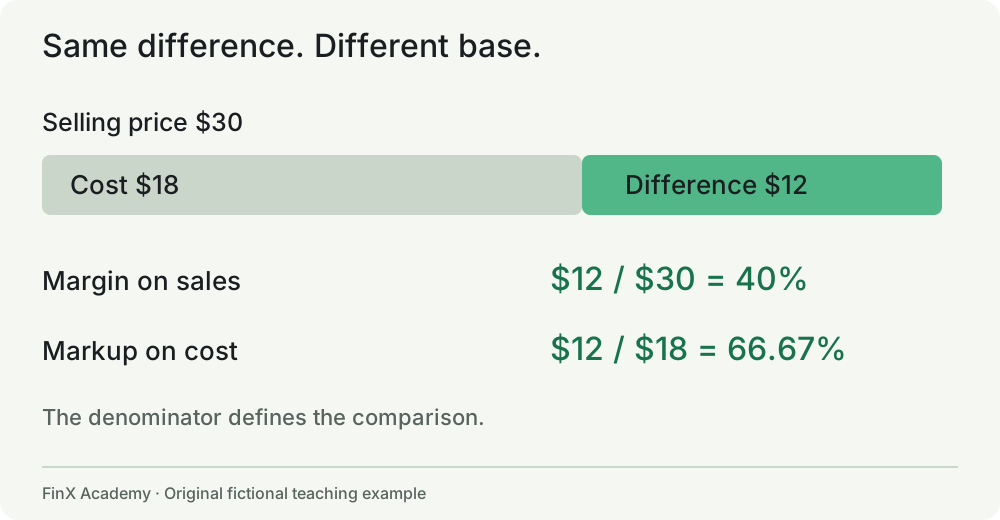
Northstar buys a bottle for $18 and sells it for $30. The difference is $12. One colleague calls that a 40% margin; another calls it a 66.7% markup. Both can be right. They are dividing by different amounts.
By the end of this lesson: you can identify the base of a percentage, explain percentage-point changes, convert between margin and markup, and aggregate ratios with suitable weights.
Percent means “per hundred.” The decimal 0.08, fraction 8/100 and percentage 8% represent the same proportion. Eight percent of $250 is 0.08 × $250 = $20. To find the percentage represented by $20 out of $250, divide: 20/250 = 0.08 = 8%.
The denominator is the base. Label it before calculating. “Costs are 60%” is incomplete. Sixty percent of revenue? Of last year's costs? Of the budget? Percentages become meaningful only after the comparison is specified.
For a change between two positive amounts:
Percentage change = (new amount − old amount) / old amount.
Sales rising from $100,000 to $120,000 increase by $20,000, or 20% of the original $100,000. Reversing that move is a decline of 20,000/120,000 = 16.67%, because the starting base has changed. A 20% rise followed by a 20% fall takes 100 to 120 to 96. It does not return to 100.
If the old value is zero, the standard percentage-change calculation is undefined. Report the absolute change and the starting point. If profit moves from a loss of $10,000 to a profit of $5,000, division by the negative base gives −150%, which is easily misread. Say “a $15,000 improvement, from a loss to a profit” and explain the crossing of zero. Do not hide these cases behind a convenient zero result.
A margin increases from 20% to 25%. Its change is 5 percentage points, or 500 basis points. One basis point is one hundredth of a percentage point: 0.01 percentage point, or 0.0001 as a decimal.
The relative increase in the margin is 5/20 = 25%. These statements answer different questions. “Margin increased five percent” is ambiguous: it could mean 20% became 21%, or someone might incorrectly intend 25%. Write “five percentage points” when subtracting two percentage levels.
| Calculation | Formula | Northstar example |
|---|---|---|
| Difference per bottle | Price − relevant cost | $30 − $18 = $12 |
| Margin on sales | Difference / selling price | $12 / $30 = 40% |
| Markup on cost | Difference / cost | $12 / $18 = 66.67% |
The word “margin” also needs a definition. Gross margin normally uses revenue minus cost of goods sold. Operating margin includes operating expenses. Contribution margin subtracts costs that vary with activity. Our $18 is the variable cost in this teaching case; its contribution margin is 40%. Do not call it gross margin in a real business without checking which costs are included.
If a product costs $80 and needs a 20% margin on sales, the price is 80/(1 − 0.20) = $100. Multiplying cost by 1.20 gives $96, a 20% markup and a margin of 16/96 = 16.67%. The mistaken price looks plausible because the arithmetic is correct; the denominator answers the wrong question.
For positive prices and costs, margin = markup/(1 + markup), and markup = margin/(1 − margin). These conversion formulas follow from price = cost + difference. They do not remove the need to define which costs you mean.
Northstar has two channels:
| Channel | Revenue | Contribution | Contribution margin |
|---|---|---|---|
| Direct | $90,000 | $36,000 | 40% |
| Wholesale | $10,000 | $2,000 | 20% |
| Total | $100,000 | $38,000 | 38% |
The simple mean of 40% and 20% is 30%. It gives a small channel the same importance as a large one. The business margin is total contribution divided by total revenue: 38,000/100,000 = 38%.
Equivalently, weight each margin by its share of revenue: 40% × 90% + 20% × 10% = 38%. The denominator tells you the weight. Revenue weights aggregate margins; units sold weight average selling prices. If one channel sells 100 bottles for $30 and another sells 300 for $20, the average selling price is (100 × 30 + 300 × 20)/400 = $22.50, not $25.
A mix shift can change the total margin even when neither channel changes its own margin. If the two channels each provide $50,000 of revenue, the overall margin becomes 30%. That decline is a composition effect, not proof that unit economics worsened within each channel.
Transfer task: rewrite “profitability improved by 10%” as two precise possible statements, then name the additional information needed to know which was intended. For formula-specific practice later, use the percentage-change guide.