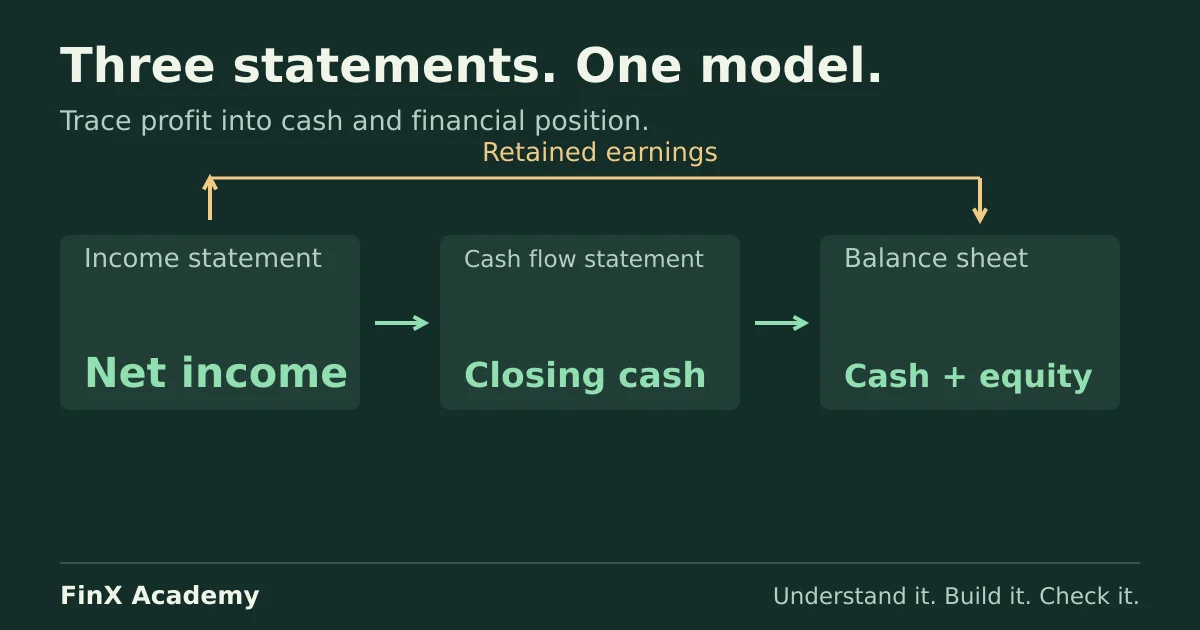
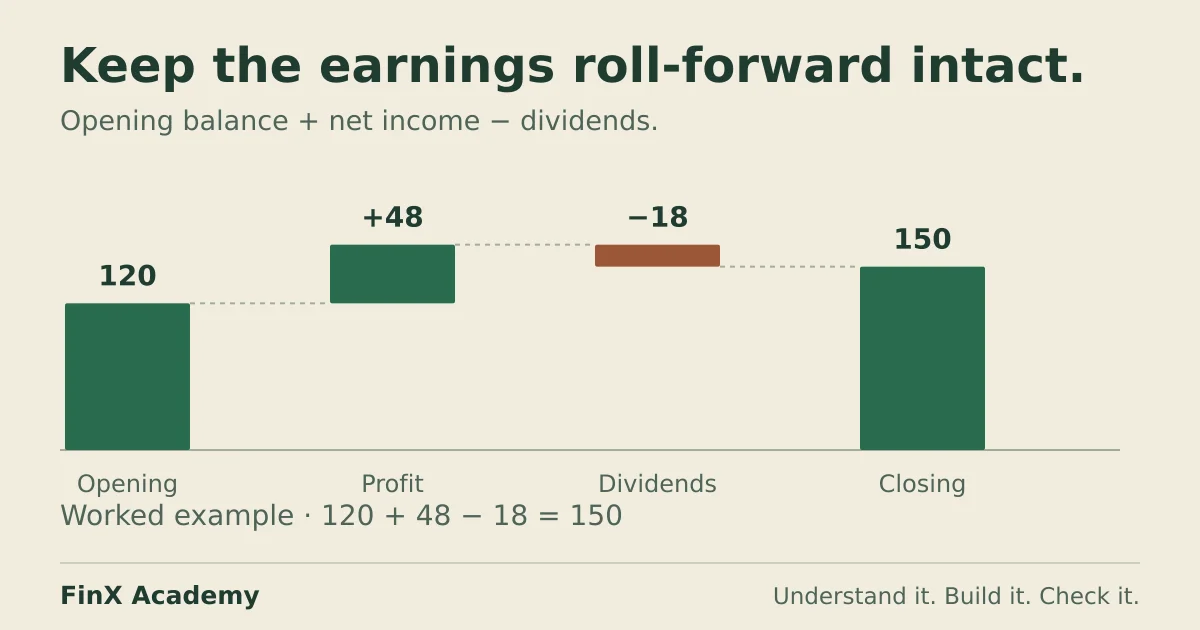
Retained earnings roll forward as opening balance plus net income minus dividends. A dividend sign error overstates equity by twice the dividend, and the balance check exposes it.
The retained earnings formula is a roll-forward, not a ratio:
Closing retained earnings = Opening retained earnings + Net income − DividendsNet income can be negative; adding a loss reduces retained earnings through the same formula. Ordinary cash dividends are distributions to shareholders, not income-statement expenses. Retained earnings is a cumulative equity account, not a pot of cash: its balance alone does not establish the cash available or permission to pay a dividend. The SEC’s financial-statement guide explains how the statements relate; this article works the retained-earnings link with a small example you can rebuild.
Agree the inputs first
Use this fictional business over two years, with every amount in the same illustrative units:
| Income statement | Year 1 | Year 2 |
|---|---|---|
| Revenue | 300 | 240 |
| Cash operating costs | 210 | 230 |
| Depreciation | 20 | 20 |
| Interest | 10 | 10 |
| Tax | 12 | 0 |
| Net income | 48 | −20 |
Year 2 is a loss year, and the example recognises no tax benefit on that loss — a deliberate simplification, stated rather than hidden. Further assumptions: opening retained earnings are 120, ordinary cash dividends of 18 and 5 are declared and paid in years 1 and 2 respectively, share capital stays at 200, and there are no other equity movements or adjustments to opening retained earnings. Assume those dividends are permitted and funded. This example classifies their cash payments as financing outflows and has no unpaid dividend liability.
Build the two-year roll-forward
Enter the assumptions and formulas below in a blank worksheet. The convention matters: enter dividends as positive amounts and let the formula subtract them. Labels go in columns A and C.
| Cell | Input | Value | Result |
|---|---|---|---|
| B3 | Opening retained earnings | 120 |
120 |
| B4 | Year 1 net income | 48 |
48 |
| B5 | Year 1 dividends | 18 |
18 |
| B6 | Year 2 net income | -20 |
−20 |
| B7 | Year 2 dividends | 5 |
5 |
| Cell | Roll-forward | Formula | Result |
|---|---|---|---|
| D3 | Closing retained earnings, year 1 | =B3+B4-B5 |
150 |
| D4 | Closing retained earnings, year 2 | =D3+B6-B7 |
125 |
Year 2 works through the same formula: 150 + (−20) − 5 = 125. Adding the loss reduces the balance; there is no separate loss formula. The assumed dividend of 5 reduces retained earnings again. Its payment is a financing cash outflow under this example’s convention; the roll-forward records the equity effect. If declaration and payment occurred in different years, the retained-earnings reduction and cash outflow would need a dividend-payable reconciliation.
Reconcile to balance-sheet equity
Retained earnings is one component of equity. With share capital constant at 200, total equity is:
| Cell | Equity | Formula | Result |
|---|---|---|---|
| D6 | Total equity, year 1 | =200+D3 |
350 |
| D7 | Total equity, year 2 | =200+D4 |
325 |
The share-capital amount is written directly into these short formulas to keep the exercise compact; in a forecast, link it to the previous period’s closing balances as the three-statement guide shows.
The reconciliation runs in both directions. The roll-forward’s closing balance must equal the balance sheet’s equity minus share capital and any other equity components. If cumulative losses and dividends ever exceed the opening balance, retained earnings goes negative — an accumulated deficit. That is a legitimate reported figure to display, not an error to force back to zero.
To reproduce the cash effect and balance check, assume opening cash of 100, net property, plant and equipment (PP&E) of 300, and liabilities of 80. There is no capex, working-capital change, borrowing or repayment. All income-statement items except depreciation affect cash in their stated year, so operating cash flow is net income plus depreciation: 68 in year 1 and 0 in year 2.
| Balance or check | Opening | Year 1 | Year 2 |
|---|---|---|---|
| Cash | 100 | 150 | 145 |
| Net PP&E | 300 | 280 | 260 |
| Total assets | 400 | 430 | 405 |
| Liabilities | 80 | 80 | 80 |
| Share capital + retained earnings | 320 | 350 | 325 |
| Assets − liabilities − equity | 0 | 0 | 0 |
Cash is 100 + 48 + 20 − 18 = 150 in year 1, then 150 − 20 + 20 − 5 = 145 in year 2. Net PP&E falls by depreciation of 20 each year. Use the actual paid dividends of 18 and 5 for these cash calculations, and keep them unchanged during the sign-error exercise below.
Catch the dividend sign error
Now break the retained-earnings input in one controlled way. Re-enter B5 as -18, keeping the subtracting formula unchanged and the actual cash payment at 18:
D3 = 120 + 48 − (−18) = 186Closing retained earnings jump to 186 instead of 150, and the mistake has two visible symptoms:
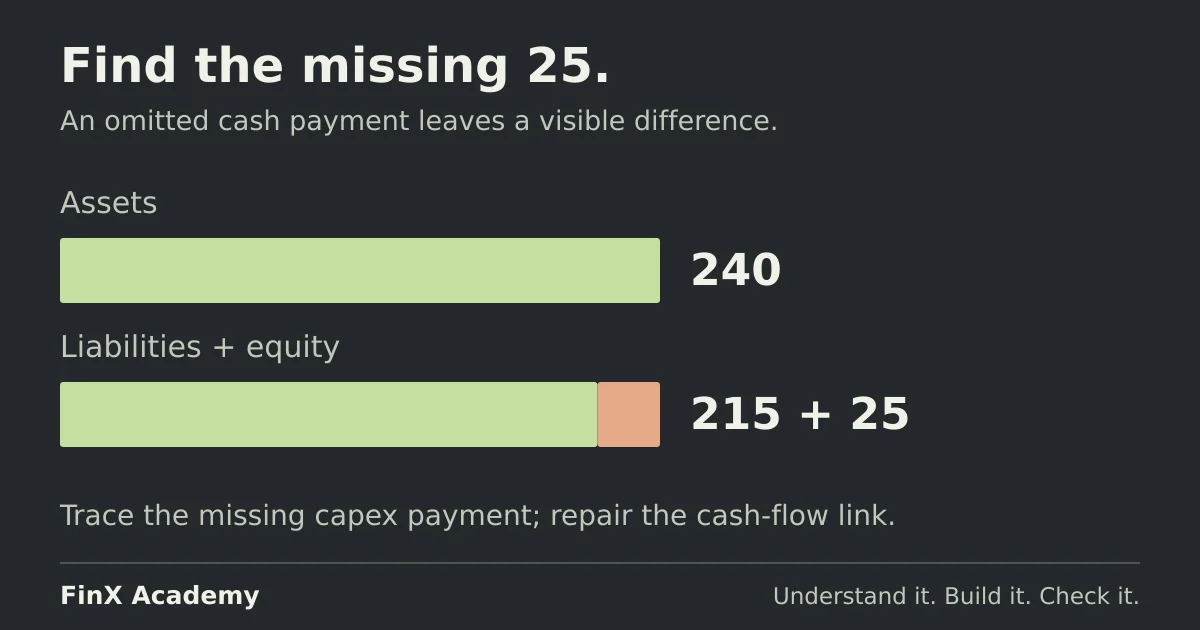
- Equity is overstated by exactly twice the dividend. Total equity for year 1 reads 386 instead of 350. If the rest of the model is correct, the balance check (assets − liabilities − equity) reads −36 while the cash flow statement still shows the 18 outflow.
- The error persists. Year 2 starts from the corrupted 186 and closes at 161 instead of 125 — the same +36 overstatement carried forward, which is why you fix the earliest broken period first.
Repair the input convention, not the formula: restore B5 to 18. Then confirm the schedule responds correctly to a real change. Raise both the year 1 dividend assumption and its actual cash payment from 18 to 24. D3 falls to 144 and D4 to 119; cash falls to 144 and 139. Equity and cash are each six lower in both years, so the balance checks remain zero. Changing only the retained-earnings input would leave cash inconsistent and the checks non-zero.
A sign error always moves retained earnings in the direction opposite to the dividend: paying more should reduce the closing balance. If a larger dividend increases it, the convention is inverted somewhere.
Watch for the second double-count
A related mistake hides dividends inside net income. If year 1 net income were calculated as 48 − 18 = 30 and the roll-forward then subtracted the 18 again, closing retained earnings would be 132 — understated by exactly one dividend. The balance check may still pass if the same wrong net income flows through the cash flow statement, which is what makes this error quieter than the sign error.
Recompute net income from revenue and expenses as well as comparing the linked figures: year 1 must be 300 − 210 − 20 − 10 − 12 = 48, with no dividend deduction. The roll-forward must use that same 48. Merely linking two copies of an incorrectly calculated net income of 30 would not detect the error. Under this example’s assumptions, dividends reduce equity and appear separately as financing cash outflows.
Keep the roll-forward honest with four checks
- Net income is correctly calculated from revenue and expenses, and the schedule uses that same figure.
- Positive schedule dividends equal the magnitude of the negative financing cash outflow, under the assumption that declaration and payment happen in the same year.
- Share capital plus closing retained earnings equals total equity in this example, which has no other equity components.
- Changing an actual dividend updates both the equity schedule and cash payment; the effect carries into later years and the balance checks remain zero.
A zero balance check alone does not prove the schedule correct — offsetting errors can hide, as the balance-sheet troubleshooting example demonstrates. Reconcile the individual balances as well.
Take the next practice step
This roll-forward is one link in a complete model. The three-statement guide builds the full set of connections, including the cash effects of the same dividends. If a check comes back non-zero, work through the balance-sheet diagnosis before changing any figure.
To assess your starting point, try the free modelling diagnostic: five questions in ten minutes, marked on numeric answers. For structured spreadsheet practice, browse the FinX course catalogue, which shows each lesson’s current access requirements.
Continue with guided practice
Connect the schedules in one integrated income statement, balance sheet and cash flow model. Explore The 3-Statement Build syllabus and start with a free lesson.
The 3-Statement Build course