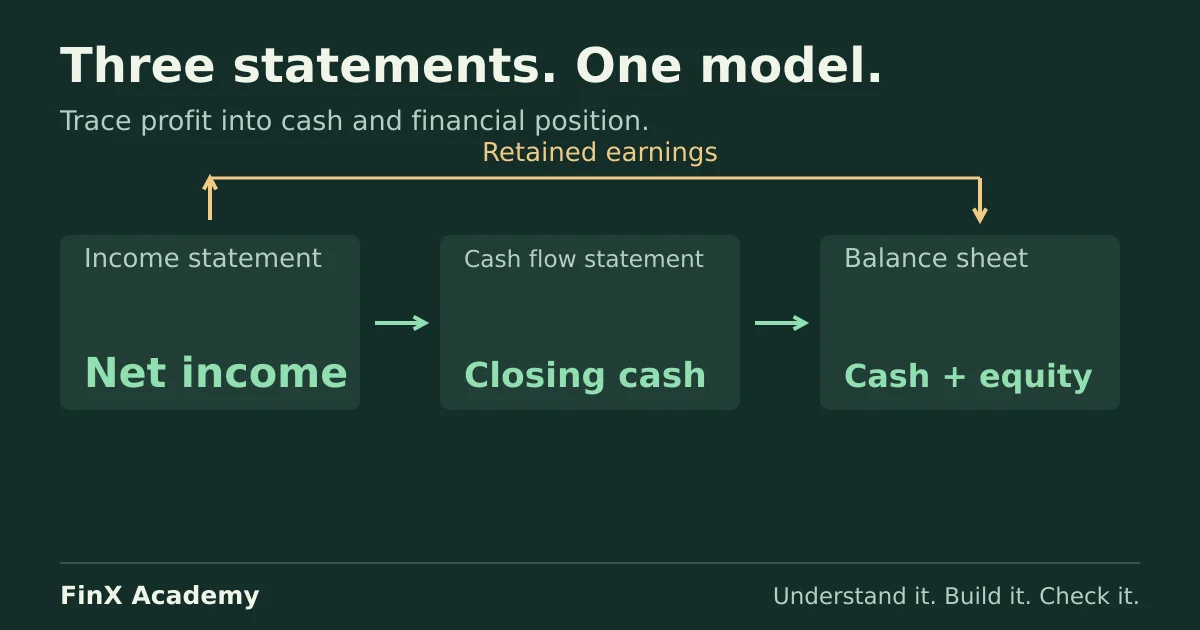
A three-statement model is a connected explanation of profit, cash and financial position. Its checks should reveal a broken link, not conceal it.
A three-statement model links a business’s income statement, cash flow statement and balance sheet. The aim is to show how the same assumptions affect profit, cash movement and the closing financial position.
The statements serve different purposes. A profitable business can still use cash, and a cash receipt does not always represent revenue. Building the links makes those distinctions visible.
Know what each statement explains
| Statement | Main question | A key connection |
|---|---|---|
| Income statement | What profit or loss arose during the period? | Net income feeds retained earnings and the indirect cash flow calculation |
| Cash flow statement | Why did cash change? | Closing cash feeds the balance sheet |
| Balance sheet | What does the business own and owe at a point in time? | Assets must equal liabilities plus equity |
This is a modelling introduction, not a complete financial-reporting standard. The SEC’s introduction to financial statements provides context on the different statements and why they should be read together.
Walk through a deliberately small example
Assume a fictional business starts with:
- Cash of 50.
- Net property and equipment of 100.
- Debt of 60.
- Equity of 90.
Opening assets are 150 and opening liabilities plus equity are also 150.
During the year, assume revenue of 120, cash operating costs of 80, depreciation of 10, interest expense of 5 and tax expense of 5. Net income is:
120 - 80 - 10 - 5 - 5 = 20For this simplified example, assume all revenue and the cash expenses are collected or paid in the year, no working-capital balances change, no new equipment is bought, no debt is drawn or repaid, and no dividends are paid.
Under those assumptions, cash from operations is net income of 20 plus non-cash depreciation of 10: 30. Closing cash is therefore 80.
Link the closing balances
Depreciation reduces net property and equipment from 100 to 90. Net income increases equity from 90 to 110 through retained earnings. Debt remains 60.
| Closing balance | Amount |
|---|---|
| Cash | 80 |
| Net property and equipment | 90 |
| Total assets | 170 |
| Debt | 60 |
| Equity | 110 |
| Total liabilities plus equity | 170 |
The model balances because the same activity is reflected consistently across the statements. The figures are illustrative; a real model needs more accounts, more assumptions and appropriate accounting treatment.
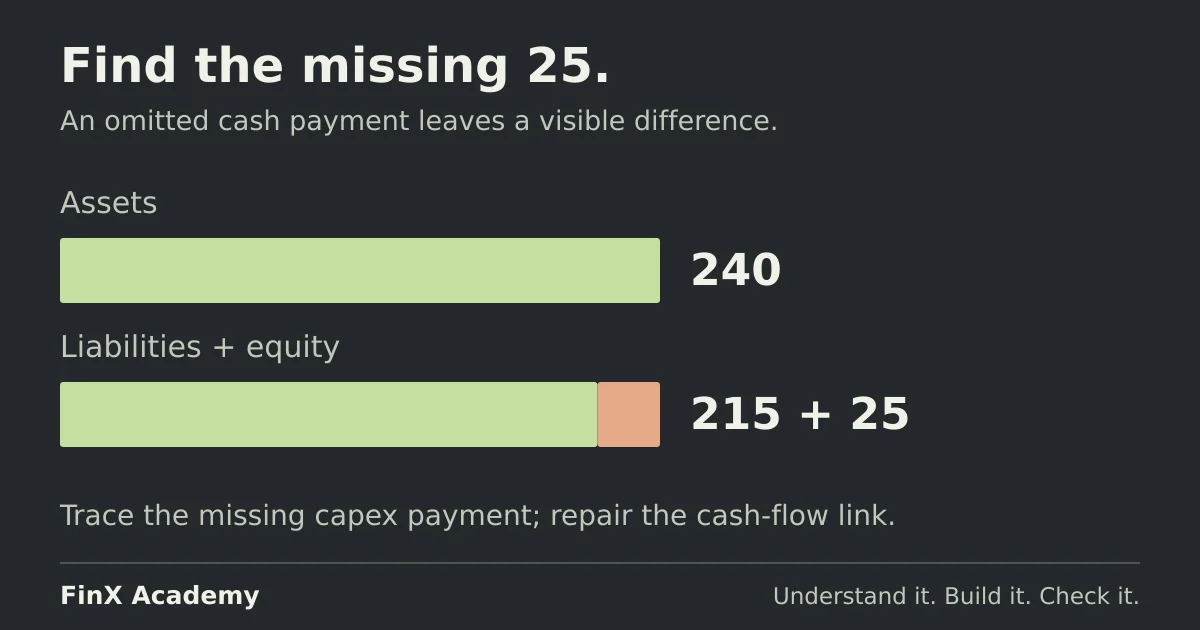
Notice what would happen if you forgot to add depreciation back in the indirect cash flow calculation. Closing cash would be 70 rather than 80. Assets would be 160, while liabilities and equity would still total 170. The difference points you towards a missing connection.
Add detail through supporting schedules
Once the basic links are understood, supporting schedules can make the model easier to build and review.
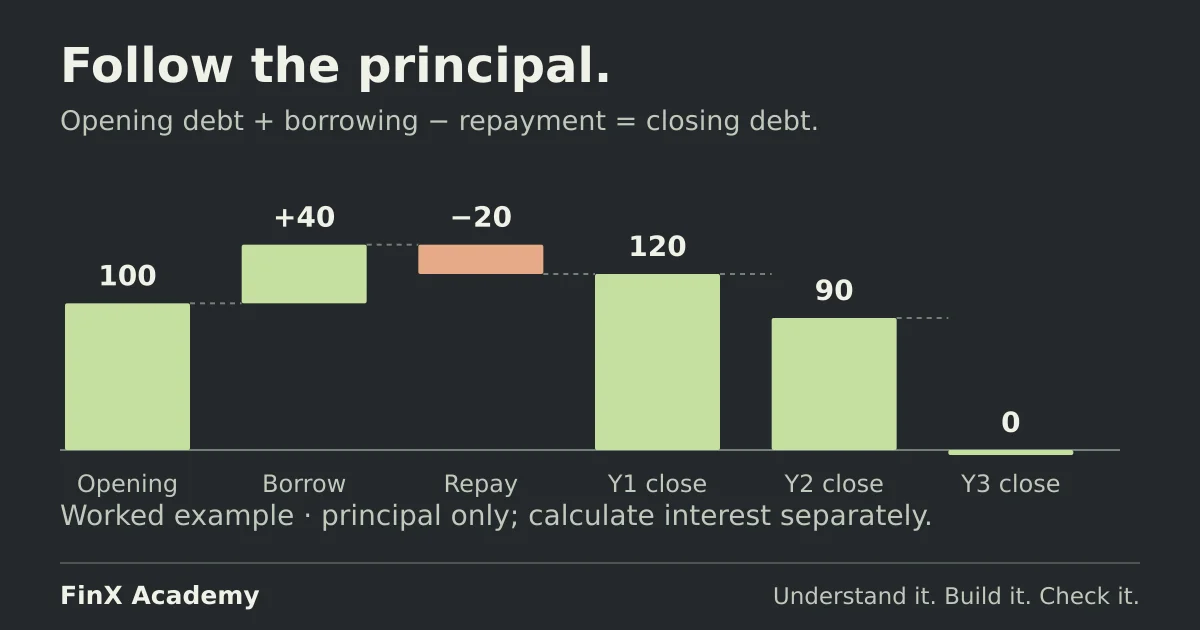
A working-capital schedule explains changes in receivables, inventory and payables. A depreciation schedule connects opening assets, capital expenditure, depreciation and net property and equipment. A debt schedule connects opening debt, new borrowing, repayments and closing debt, with an explicit method for interest.
The worked debt schedule expands that last connection with repayments and interest across three years.
Keep each assumption’s units and timing clear. An annual interest rate applied to an average balance is a different assumption from interest calculated on a closing balance. Choose a method appropriate to the exercise and explain it.
Do not add circularity just because a more detailed model might eventually need it. First establish a model you can follow and check.
Use checks to investigate mistakes
A balance check is a diagnostic:
Total assets - Total liabilities - Total equityIts expected value is zero, subject to an appropriate rounding tolerance. A zero result is necessary, but it does not prove every assumption or formula is correct. Two mistakes can offset each other.
Use additional checks:
- Closing cash on the cash flow statement matches balance-sheet cash.
- Debt balances reconcile to the debt schedule.
- Retained earnings reconcile from the opening balance and period movements.
- An input change affects the intended forecast periods and accounts.
If the balance difference is non-zero, use the balance-sheet troubleshooting example to isolate a missing cash-flow entry and test the correction.
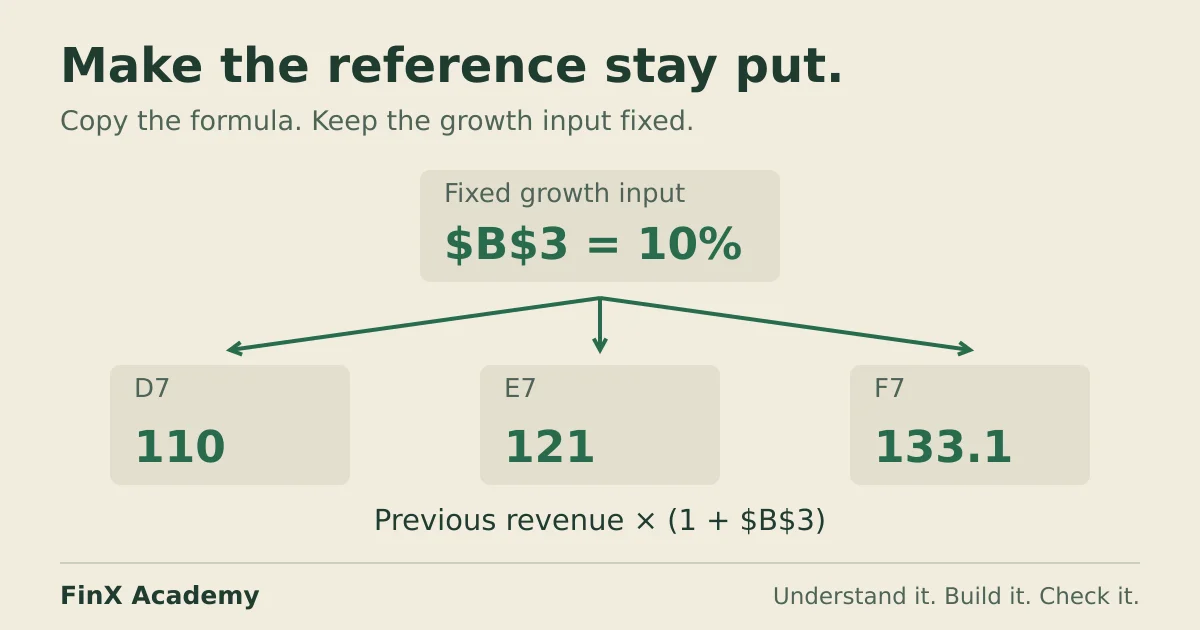
Inspect formulas at the edges of copied ranges. A reference mistake can leave the first year correct and break the later years; the absolute-reference guide shows this on a smaller scale.
Take the next practice step
FinX’s Three-Statement Build course provides structured spreadsheet practice. Browse the course catalogue to see the current syllabus and access requirements.
If you want a short starting point, try the free modelling diagnostic. It has five questions and a ten-minute limit. It checks selected skills rather than asking you to build a complete three-statement model or reproducing an employer’s assessment.
For a separate monthly example, the revenue-forecast guide builds the top line from contract counts, prices and completed jobs, then reconciles it to an annual total. For a separate ratio exercise, the ROIC guide reconciles after-tax operating profit and invested capital using a stated fictional balance sheet.
Continue with guided practice
Connect the schedules in one integrated income statement, balance sheet and cash flow model. Explore The 3-Statement Build syllabus and start with a free lesson.
The 3-Statement Build course