Post each transaction, reconcile the statements and explain where the cash went.
Explain how transactions affect profit, cash and the balance sheet. This free nine-lesson course starts with double-entry accounting and finishes with a journal that produces linked financial statements.
Prerequisite: financial numeracy. Excel foundations can run alongside this course. All company facts are original fictional teaching data, in USD thousands. The accounting-policy cutoff is 8 October 2026.
Download the editable case workbook and transaction source. Complete the blank journal before opening the worked answers. The public solutions support practice; this is not an unseen certification.
1. Post both sides of a transaction
An analyst needs to explain what happened before deciding which cell to change. A business owns resources, owes claims to others and has a residual claim belonging to owners. The accounting equation is assets = liabilities + equity. It must still hold after each transaction.
Debits and credits are the two sides of an entry. They do not mean good and bad, or cash in and cash out. An asset or expense normally increases with a debit. A liability, equity or revenue account normally increases with a credit. A decrease uses the opposite side. Accumulated depreciation is a contra-asset: its credit balance reduces equipment’s carrying amount.
| Event, USD thousands | Debit | Credit | Immediate profit effect |
|---|---|---|---|
| Owner contributes 100 | Cash 100 | Share capital 100 | 0 |
| Buy inventory on credit for 40 | Inventory 40 | Payables 40 | 0 |
| Sell goods on credit for 100 | Receivables 100 | Revenue 100 | +100 |
| Goods delivered cost 40 | Cost of sales 40 | Inventory 40 | −40 |
| Customer pays 70 | Cash 70 | Receivables 70 | 0 |
The sale requires two entries in this simple perpetual-inventory example. Recording revenue alone would overstate profit and leave sold goods in inventory. Collection settles a receivable. Recognizing revenue again on collection would count the same sale twice.
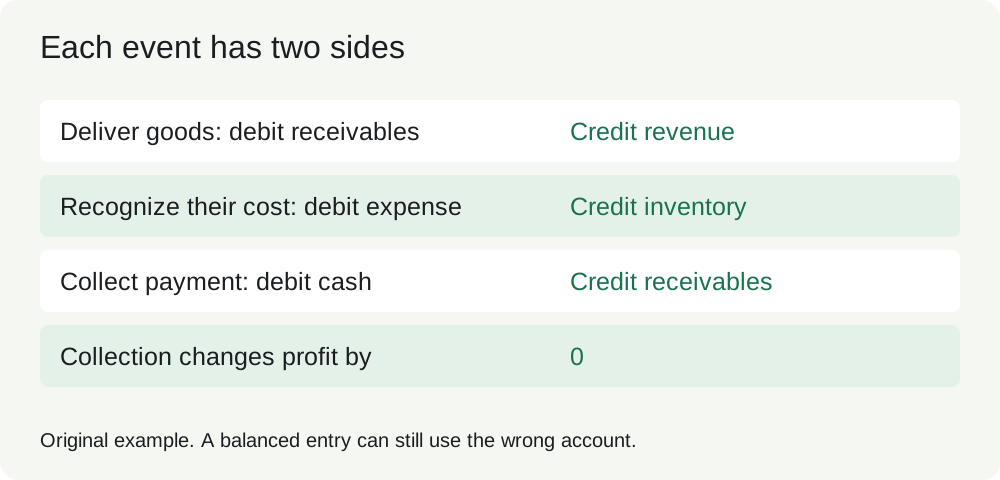
Worked check. Begin with cash 100 and share capital 100. Buy goods for 40 on credit, sell them for 100 on credit, then collect 70. Assets are cash 170 plus receivables 30 = 200. Liabilities are payables 40. Equity is contributed capital 100 plus profit 60 = 160. Both sides equal 200. Equal debits and credits establish arithmetic balance; they do not prove the chosen accounts or dates are correct.
Try it. Instead collect only 50. Record the collection entry and recompute cash and receivables before reading on.
Check your answer. Debit Cash 50, credit Receivables 50. Cash is 150, receivables 50 and total assets still 200. Profit remains 60. If profit changes, you have treated collection as another sale. Repair that entry, then repeat with a collection of 80.
Explain in one sentence: identify the business event, the two affected accounts and why cash and profit can respond differently. The IDE checks formula results; this explanation needs self-review or a tutor.
2. Read three linked statements
The income statement measures revenue and expenses over a period. The balance sheet measures assets, liabilities and equity at a date. The cash-flow statement explains the change in cash over the same period. A full reporting package also includes changes in equity and notes. These lessons concentrate on the three statements an analyst links in a basic model. SEC introduction
Accrual accounting records performance when the relevant recognition conditions are met. The payment date can fall earlier or later. An invoice alone does not prove revenue was earned; inspect delivery, contractual rights and the remaining obligations. In our original examples, goods have been delivered and the customer controls them, so revenue and a receivable are recognized.
Suppose delivered services earn 80, customers pay 50 and staff earn 30, of which 25 is paid. There is no tax or depreciation in this small example. Profit is 80 − 30 = 50. Operating cash is 50 − 25 = 25. Receivables rise by 30 and accrued payroll rises by 5. Starting from profit, 50 − 30 + 5 = 25 reconstructs the same operating cash.
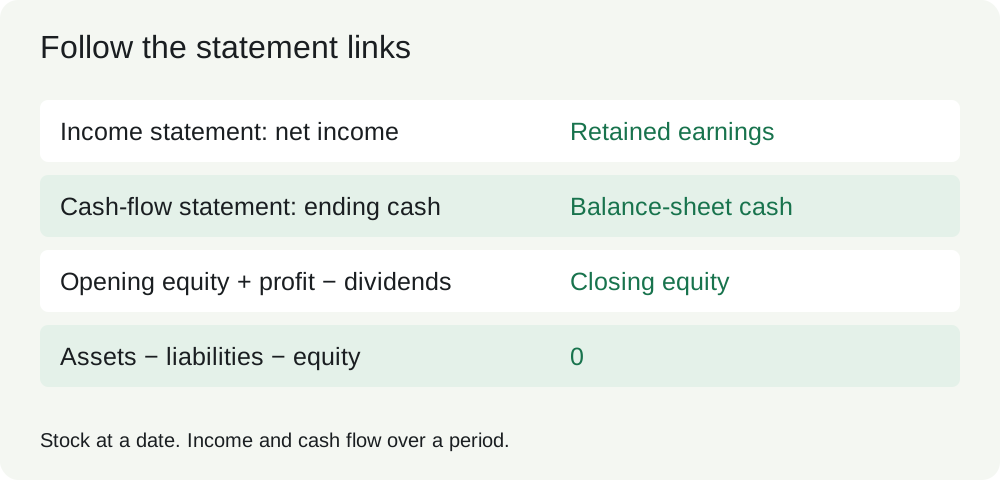
The indirect cash-flow bridge removes noncash charges and adjusts for operating timing differences. An increase in receivables uses cash relative to recognized revenue. An increase in an operating payable preserves cash relative to recognized expense. Here and in the final case, there are no acquisitions, foreign-exchange effects or write-offs. In a real filing, those can make a raw balance-sheet change differ from the cash-flow adjustment. IAS 7 overview
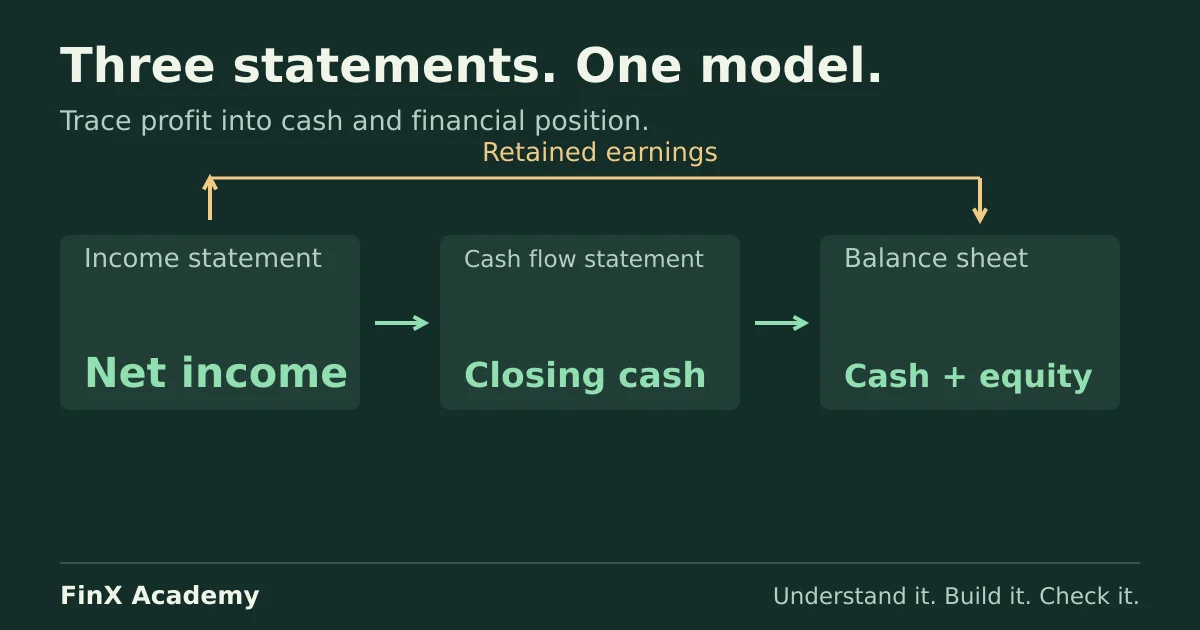
Three links should remain visible: net income feeds retained earnings, ending cash from the cash-flow statement equals balance-sheet cash, and assets minus liabilities minus equity equals zero. Retained earnings roll forward as opening retained earnings plus net income minus dividends in this simplified case. Do not change cash to make the balance sheet balance. Reconcile the error to its source.
Try it. Customers pay another 10 before period-end, with no new service. Recalculate profit, receivables and operating cash.
Check your answer. Profit remains 50. Receivables fall from 30 to 20. Operating cash rises from 25 to 35. If cash does not change, inspect the collection entry. If profit changes, inspect whether the collection was mistakenly posted to revenue.
Transfer task. If the unpaid payroll is settled next month, that payment reduces next month’s cash and opening payroll liability. It does not create the same payroll expense twice. Explain which reporting period owns the work.
3. Follow revenue and operating working capital
Revenue follows the transfer of promised goods or services, not automatically the invoice or cash date. IFRS 15 organizes the analysis around the contract, performance obligations, transaction price, allocation and satisfaction of those obligations. Complex contracts need more work than the simple delivered goods and service examples here. IFRS 15
Harbor Supply invoices 160 for delivered goods and collects 100. Opening receivables are zero, so closing receivables are 0 + 160 − 100 = 60. The 60 was included in revenue but remains uncollected. Separately, a customer prepays 20 for future service. Harbor performs 5 by month-end. Receipt debits cash and credits deferred revenue 20. Performance debits deferred revenue and credits revenue 5. The remaining liability is 15. Total recognized revenue is 165, while customer cash receipts are 120.
Inventory also separates a purchase from an expense. Harbor buys 100 of goods on credit, delivers goods costing 70 and pays suppliers 80. Closing inventory is 30 and closing payables are 20. Cost of sales is 70. Supplier cash payments are 80. In this case, purchases equal cost of sales plus the increase in inventory, and supplier payments equal purchases minus the increase in payables.
| Operating account increase | Adjustment from profit to operating cash | Reason |
|---|---|---|
| Receivables 60 | −60 | Revenue not yet collected |
| Inventory 30 | −30 | Purchased goods not yet expensed |
| Payables 20 | +20 | Purchases not yet paid |
| Accrued payroll 5 | +5 | Staff expense not yet paid |
| Deferred revenue 15 | +15 | Cash received ahead of performance |
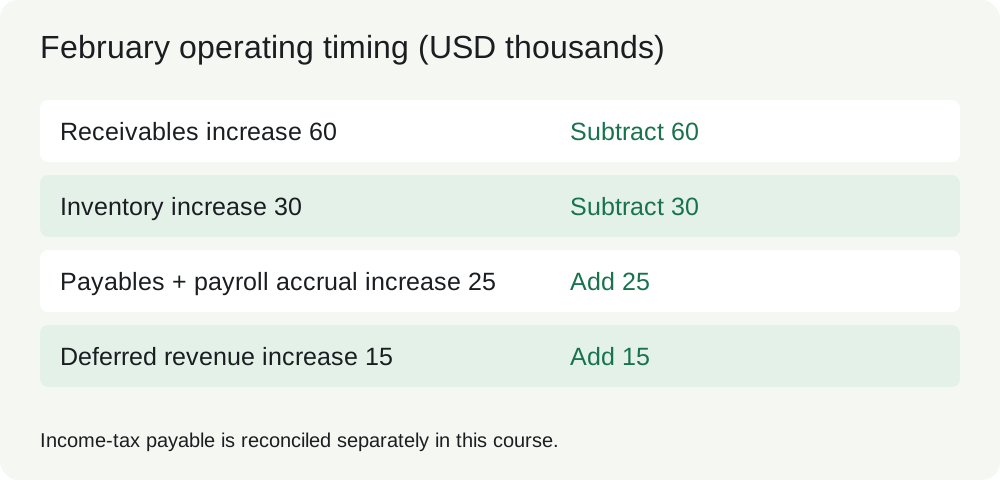
Operating working capital in this lesson includes receivables and inventory less trade payables, accrued payroll and deferred revenue. Cash, debt and income-tax balances are shown separately. Other analysts may define the measure differently; write the included accounts before comparing numbers. An increase in that defined net balance uses operating cash.
Try it. Collect 120 rather than 100, keeping all deliveries unchanged. Then increase purchases from 100 to 110 on unpaid credit.
Check your answer. The collection reduces receivables to 40 and increases cash by 20 without changing profit. The extra unpaid purchase increases inventory and payables by 10 each; neither profit nor cash changes. Buying inventory is not automatically an immediate expense or cash outflow. Reverse each test before starting the next.
Diagnosis. If all prepaid cash is counted as revenue, revenue is overstated by 15 and deferred revenue understated by 15. A balanced trial balance will not detect that recognition error. Compare the posting with the service obligation.
4. Separate investment from depreciation
A qualifying long-lived asset gives benefits beyond the current period. Capitalizing its cost places an asset on the balance sheet. Depreciation allocates depreciable cost over its useful life once available for use; amortization performs a similar role for finite-lived intangible assets. The recognition conditions, useful life, residual value and impairment assessment matter. Routine repairs are generally expenses; describing a cost as an investment does not by itself justify capitalization. IAS 16
Harbor buys equipment for 60 cash on February 1 and can use it immediately. Assume a 12-month useful life, zero residual value, straight-line depreciation and one full month in February. Monthly depreciation is (60 − 0) / 12 = 5. Debit equipment 60 and credit cash 60 on purchase. At month-end debit depreciation expense 5 and credit accumulated depreciation 5. Gross equipment is 60, accumulated depreciation is 5 and net equipment is 55.
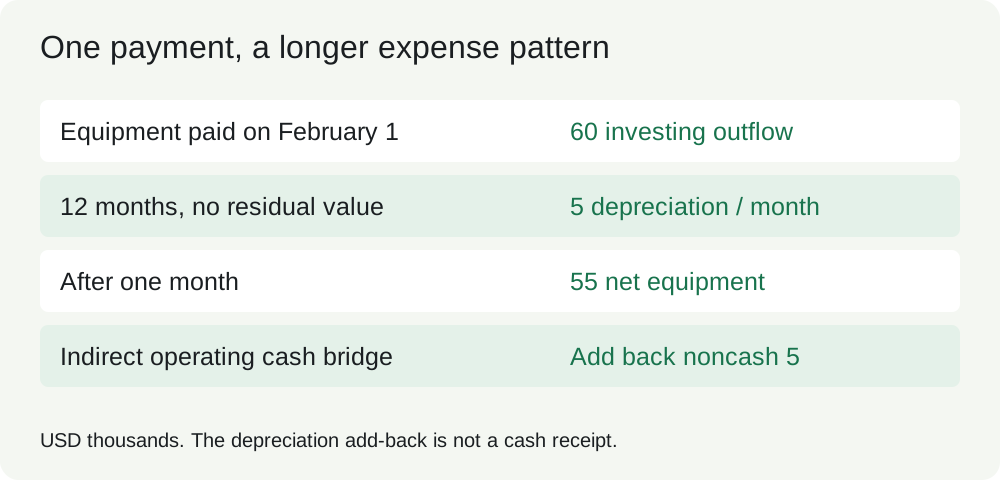
The income statement includes 5 of expense. Investing cash flow includes the 60 payment. The indirect operating cash flow adds back the 5 noncash charge that reduced net income. The add-back is a reconciliation, not a new cash receipt. Subtracting both depreciation and capex as cash payments would count the asset cost twice across the cash-flow calculation.
Try it. A separate asset costs 96, has a residual value of 12 and a 24-month life. It is available for use at the start of the month. Calculate monthly depreciation and carrying amount after six full months.
Check your answer. Monthly depreciation is 3.5. Accumulated depreciation is 21 and carrying amount is 75. If the result is 4 per month, you forgot residual value. For a finite-lived license costing 24 over 12 months with no residual value, monthly amortization would be 2 under the same simplified timing assumption.
Transfer task. If an asset is acquired with debt rather than paid for in cash at inception, the initial noncash acquisition is disclosed separately from cash flows. Later principal and interest payments still need classification. Do not assume every increase in equipment equals cash capex. IAS 7
Changing a useful-life estimate changes future allocation under the applicable rules; it does not erase the original payment. The final case fixes the convention so the comparison does not mix business changes with accounting-policy changes.
5. Keep financing separate from operating performance
Borrowing creates cash and a repayment obligation. It is not revenue. Repaying principal reduces that obligation and cash; it is not interest expense. Equity issuance increases cash and contributed capital. A dividend distributes equity to owners and does not reduce the period’s net income.
Harbor begins February without debt, borrows 30 and repays 10. Closing debt is 0 + 30 − 10 = 20. It pays and expenses interest of 2. In this teaching case, interest paid is operating cash flow, while borrowing and principal repayments are financing cash flows. These are stated classifications, not a universal rule for every framework or reporting year.
The company also issues shares for 20 and declares and immediately pays a dividend of 10. Financing cash flow is 30 − 10 + 20 − 10 = 30. Share capital rises from 100 to 120. With opening retained earnings 22.5 and February profit 36, closing retained earnings are 22.5 + 36 − 10 = 48.5. Closing total equity is 168.5.
| Item | Profit effect | Cash effect in this case | Balance-sheet effect |
|---|---|---|---|
| Borrow 30 | 0 | Financing +30 | Debt +30 |
| Repay principal 10 | 0 | Financing −10 | Debt −10 |
| Pay interest 2 | −2 before tax | Operating −2 | Cash −2 |
| Issue shares 20 | 0 | Financing +20 | Share capital +20 |
| Pay dividend 10 | 0 | Financing −10 | Retained earnings −10 |
Try it. Borrow another 15 just before month-end with no extra interest in the period. Calculate debt, cash and net income changes.
Check your answer. Debt and cash each rise by 15; net income is unchanged. Extra cash funded by debt does not establish stronger operating cash generation. If interest accrues but is unpaid, recognize the expense and interest payable, then reconcile the payable in operating cash under this case’s classification.
Repair task. A model subtracts the 10 principal repayment in the income statement and omits it from financing cash flow. Remove it from expense and record the financing outflow. Recompute any tax calculated from pretax income. A cash balance that happens to match is insufficient if the model puts transactions in the wrong statements.
A separate statement of changes in equity makes owner transactions and earnings easier to follow. Retained earnings can be positive while available cash is low because earnings may be invested in receivables, inventory or equipment.
6. Separate book tax, current tax and cash tax
Income-tax expense belongs to the income statement. Current tax payable is a balance-sheet obligation. Cash tax is the payment during the period. Deferred tax arises from specified differences between accounting carrying amounts and tax bases, and from qualifying unused losses or credits. It is not simply the unpaid portion of this month’s tax bill. IAS 12
In Harbor’s core case, assume no permanent differences, no temporary differences, no losses and a fictional 25% tax rate. Pretax income is 48. Current tax expense is 12. Cash tax paid is 8. With zero opening tax payable, closing tax payable is 0 + 12 − 8 = 4. Net income is 36. The indirect cash bridge adds the payable increase of 4, so only 8 of tax reduces cash. This payable is not a deferred-tax liability.
Now use a separate example to understand deferred tax. Pretax accounting income is 100 after book depreciation of 10. Tax depreciation is 30, with no other differences. Taxable income is 100 + 10 − 30 = 80. At 25%, current tax is 20. Book tax expense is 25 in this simplified example. The extra tax deduction creates a taxable temporary difference of 20 and a deferred-tax liability of 5. Total tax expense is current 20 plus deferred 5. Future reversal depends on the remaining book and tax deductions.
Try it. Replace tax depreciation of 30 with 18. Calculate taxable income, current tax and the deferred-tax liability increase.
Check your answer. Taxable income is 92, current tax 23 and the liability increase 2. Book tax expense remains 25 under these assumptions. The difference reflects timing rather than a permanent tax saving. If cash paid is only 19, a further current payable of 4 arises; it is distinct from the deferred liability of 2.
A loss carryforward may reduce future taxable income where the law permits. Suppose a separate fictional regime allows unrestricted use of a 40 loss against 50 of current taxable income. The remaining taxable base is 10 and tax at 25% is 2.5. A potential deferred-tax asset of 10 before use is not automatically recognizable or equivalent to cash. Recognition depends on the applicable recoverability criteria; limits, expiry dates and tax rates depend on jurisdiction. Do not apply this fictional regime to a real company without checking its rules.
Explain: name the difference, whether it reverses and the supporting evidence for recovery. A tax-rate multiplication alone cannot establish recoverability or cash-payment timing.
7. Introduce leases, stock compensation and adjustments
An adjustment should answer a defined analytical question and reconcile to reported numbers. Preserve the reported statements, show the adjustment separately, apply it consistently and explain what economic cost remains. Label an adjusted measure clearly; an add-back does not prove an expense is exceptional.
Leases. Under IFRS 16, lessees generally recognize a right-of-use asset and lease liability, subject to exemptions. In a simple subsequent period, an opening liability of 100 plus interest of 5 less payment of 25 leaves 80. Principal repaid is 20. Separate right-of-use depreciation of 20 and interest of 5 can affect operating metrics differently from rent expense. The initial noncash asset and liability are not cash proceeds. IFRS 16
US GAAP Topic 842 retains operating and finance lessee classifications. An operating lease generally has a single lease expense, while a finance lease separates interest and amortization. Both models generally bring leases onto the balance sheet, with relevant exceptions. This affects EBITDA and cash-flow comparability; do not add lease liabilities to one peer’s debt while leaving its earnings and cash measures on an incompatible basis. FASB lease overview
Stock-based compensation. In a simplified equity-settled award, employee service creates expense and an equity credit. A noncash expense can be added back in an indirect cash reconciliation, but the potential dilution and economic compensation cost remain. Cash-settled awards have different accounting. These examples omit vesting, valuation and withholding details. IFRS 2
Worked adjustment. Reported EBIT of 40 includes depreciation of 8, equity-settled stock compensation of 6 and a separately identified restructuring charge of 4. EBITDA, defined here as EBIT plus depreciation and amortization, is 48. Excluding both other charges produces adjusted EBITDA of 58. That arithmetic says nothing about whether exclusion is useful. Recurring stock compensation and repeated restructuring may be part of the ongoing cost base. The analyst should show all three measures and explain the policy.
Try it. The restructuring charge was paid in cash this period. Does adding 4 back to adjusted EBITDA make that cash available again?
Check your answer. No. The payment remains in cash flow. A noncash/cash classification and a recurring/nonrecurring assessment are separate questions. For a transfer task, remove only the restructuring adjustment: adjusted EBITDA becomes 54, still with a disclosed stock-compensation exclusion.
These separate examples are not extra transactions in Harbor’s final ledger. Keeping them outside the core case avoids inventing lease or equity-award details that the source does not contain.
8. Read the policy before comparing the numbers
The same business cash flows can produce different reported subtotals under different accounting policies, estimates and frameworks. Begin with the reporting period, accounting framework, policy notes and any restatement. Preserve the originally reported version beside a restated version when analyzing what investors knew at the time.
Harbor is an original fictional February 2026 teaching case. It uses accrual recognition for delivered goods and completed service, the stated inventory costs, straight-line equipment depreciation over 12 months from February 1, no residual value, no deferred taxes in the core case, and a fictional 25% current tax rate. Interest and taxes paid are operating; borrowing, principal repayment, share issuance and dividends paid are financing. There are no acquisitions, foreign exchange, impairment, bad debts, leases or stock awards in its core ledger.
Date-specific comparison, checked 8 October 2026. Before IFRS 18 adoption, IAS 7 permits policy choices for certain interest and dividend cash flows. US GAAP classifications differ in some respects. For this course, using operating interest paid and financing dividends paid gives one consistent convention. IFRS 18 is effective for annual periods beginning on or after 1 January 2027, with early application permitted. It changes the indirect operating cash-flow starting subtotal and requirements for interest/dividend classification. Do not extend a 2026 template into a later reporting period without checking adoption and business-specific requirements. IAS 7 · IFRS 18
The lease example in lesson 7 supplies another relevant IFRS/US GAAP difference. A company using separate depreciation and interest can show different operating profit and EBITDA from one using a single operating-lease expense, despite similar lease payments. A comparison needs a consistent definition and a disclosed reconciliation.
Errors versus estimates. Forgetting a payroll expense that employees had already earned is an error. Revising useful life because new evidence changes expected use is an estimate change. IAS 8 generally treats estimate changes prospectively and material prior-period errors retrospectively, subject to its conditions and practicability rules. Check the actual note rather than inferring treatment from the word “adjusted.” IAS 8
Try it. A draft period reports pretax income 50, omitting earned payroll of 8. Correct it before issuing the statements. Use the fictional 25% tax rate and assume the expense is deductible.
Check your answer. Corrected pretax income is 42, tax is 10.5 and net income is 31.5. Record the unpaid payroll liability if no payment occurred. Calling the expense an analyst adjustment would leave the reported draft wrong. If the error belongs to an already-issued prior period, investigate materiality and the applicable restatement rules instead of automatically charging the current period.
Review habit. Write the source date, policy and analytical definition beside each comparison. Balanced statements are necessary; faithful recognition, consistent classification and clear versioning require additional review.
9. Case: profit rose while cash fell
Your assignment. Post Harbor Supply’s 18 February transactions into a journal, roll the accounts forward, prepare linked statements and write a four-sentence explanation of why higher profit did not produce more cash. Use USD thousands throughout. Attempt the workbook’s Journal and Statements sheets before consulting the public worked solution. Formula grading covers numerical cells; the written explanation is reviewed separately.
January began with cash and share capital of 100 and no other balances. It generated sales and collections of 100, purchased and consumed inventory of 40, paid payroll of 30 and paid tax of 7.5. January profit and operating cash flow were 22.5. February therefore opens with cash 122.5, share capital 100 and retained earnings 22.5; all other accounts start at zero.
| ID | February event | Amount |
|---|---|---|
| T01 | Buy inventory on credit | 100 |
| T02 | Deliver goods and invoice customers | 160 |
| T03 | Recognize the cost of goods delivered | 70 |
| T04 | Collect customer invoices | 100 |
| T05 | Pay suppliers | 80 |
| T06 | Recognize payroll earned | 40 |
| T07 | Pay payroll | 35 |
| T08 | Receive customer advance for future service | 20 |
| T09 | Perform part of the prepaid service | 5 |
| T10 | Buy equipment for cash, available February 1 | 60 |
| T11 | Recognize one month of depreciation | Calculate |
| T12 | Borrow from lender | 30 |
| T13 | Repay principal | 10 |
| T14 | Pay and expense interest | 2 |
| T15 | Issue shares for cash | 20 |
| T16 | Declare and pay dividend | 10 |
| T17 | Accrue current income tax | Calculate |
| T18 | Pay income taxes | 8 |
Use lesson 8’s fixed policies. T11 is 60 / 12 = 5. T17 is 25% of pretax income. First choose the debit and credit accounts, then enter an amount once per transaction. The workbook derives the trial balance and statements from those postings. Do not plug cash, retained earnings or an unnamed liability to force equality.
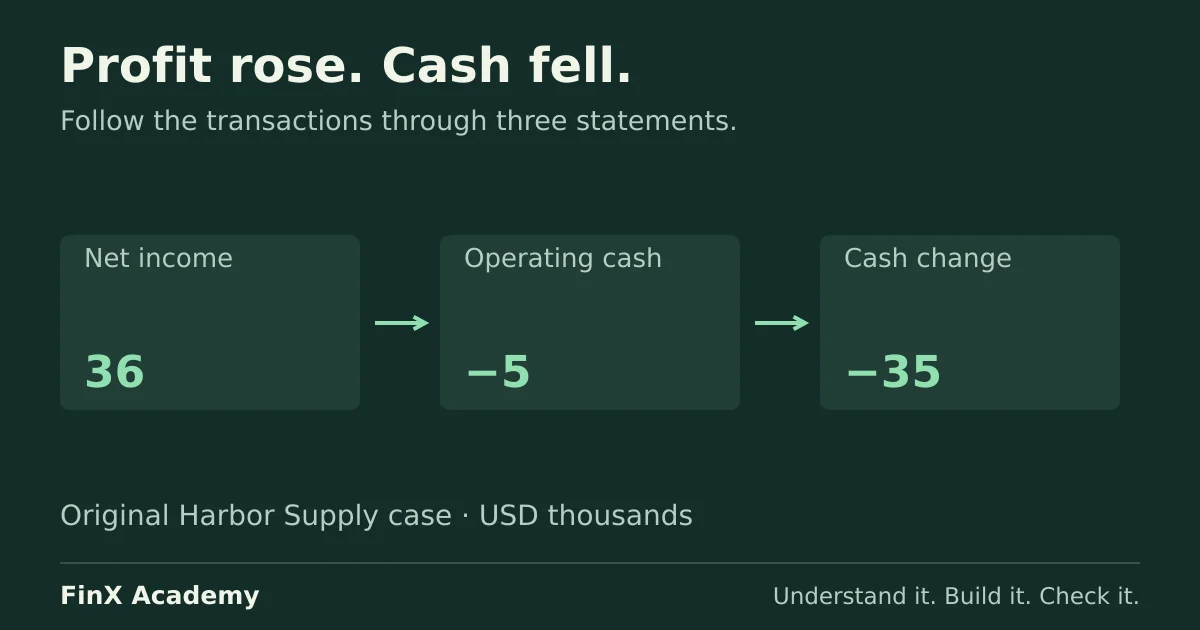
Public solution: income statement. Revenue is 160 + 5 = 165. Cost of sales is 70, payroll 40, depreciation 5 and interest 2. Pretax income is 48, tax expense 12 and net income 36. Profit rose by 13.5 from January.
Public solution: balance sheet. Cash is 87.5, receivables 60, inventory 30 and net equipment 55, giving assets of 232.5. Liabilities are payables 20, accrued payroll 5, deferred revenue 15, tax payable 4 and debt 20, totaling 64. Share capital 120 and retained earnings 48.5 give equity 168.5. Assets equal liabilities plus equity. The unclosed trial balance also balances; the reporting sheet closes income and dividends into retained earnings without double-counting them.
Public solution: operating cash. Start with profit 36. Add depreciation 5. Subtract the increases in receivables 60 and inventory 30. Add increases in payables 20, accrued payroll 5, deferred revenue 15 and current tax payable 4. Operating cash is −5. Independently, customer receipts 100 + 20 less supplier payments 80, payroll 35, interest 2 and cash taxes 8 also give −5.
Public solution: cash roll-forward. Investing cash is −60. Financing cash is 30 − 10 + 20 − 10 = +30. Total cash change is −35, so opening cash 122.5 becomes 87.5. The two cash methods, cash roll-forward and balance sheet must agree.
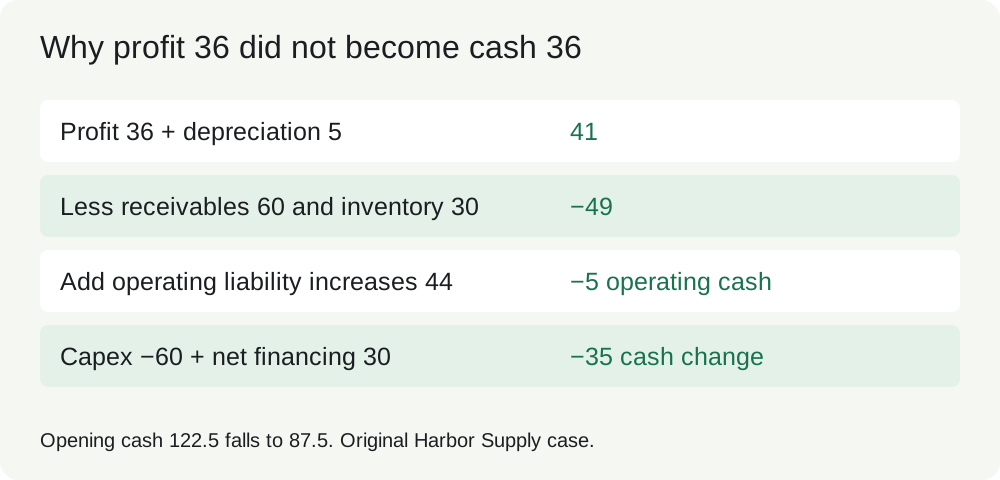
Example explanation. “February net income increased from 22.5 to 36, but operating cash fell from +22.5 to −5. Receivables and inventory absorbed 90, only partly offset by 44 of operating liability increases and the 5 noncash depreciation add-back. Equipment required a further 60 cash outflow, while net financing supplied 30. Cash therefore fell by 35 to 87.5; higher recognized profit did not ensure collection or fund all investment.”
Changed-input tests. Collect 20 more: cash becomes 107.5 and receivables 40, while net income stays 36. Restore. Purchase another 10 of inventory on unpaid credit: inventory and payables each rise 10, with no change in profit or cash. Restore. Repay 5 more principal: debt and cash each fall 5, with no current-period profit change under the fixed interest assumption. Restore before saving.
Repair task. Deliberately post T04’s credit to Revenue instead of Receivables. The trial balance still balances. Revenue and receivables are now overstated by 100 before related tax correction. Find the fault by tracing T04 to the customer settlement. Restore the correct account.
Self-review rubric. Check numerical accuracy (40%), traceable links and changed-input behavior (25%), causal reasoning (20%) and clear communication (15%). These are learning criteria, not a calibrated certification. An unexplained cash or balance-sheet discrepancy remains a material failure regardless of the score. Retry with customer collections of 90 and principal repayment of 15: net income remains 36, operating cash is −15 and closing cash is 72.5.
Post transactions and follow the cash
Start with six free exercises on transactions and linked statements. Continue with working capital, investment, financing, taxes and the Harbor case in full access. The written explanation has a separate self-review rubric.
Prefer to watch?
Follow the complete Accounting for analysts course on YouTube, then use the exercises here to practice.
Watch the full course on YouTube ↗Continue with guided practice
Practice transaction entries, working capital, depreciation, financing and taxes, then explain a profit-to-cash case.
Accounting for analysts course